Buyer's guide · Service levels
What service level to expect from AI visibility work.
Whether the proposal says GEO, AEO, or AI search, you'll leave with the five terms to write into the contract and one email that sorts the proposals on your desk.
The short answer
Expect four things in writing: a fixed set of buyer questions, a re-measure on that same set, a named number of pages shipping each week, and your approval on every page. At Resonate Labs, that means 150 questions across ChatGPT, Claude, Gemini, and Perplexity, three pages a week, and a monthly re-ask.
- WeeklyThree pages, each one yours to approve
- MonthlyThe same 150 questions, asked again
- 72 hoursUsual turnaround on the first Crawl
What should ship every week, and what every month?
A good engagement runs on two clocks: pages that ship, and a measurement that repeats. Pages should ship weekly, in a number written into the contract. The measurement should come monthly, on the same questions and the same engines as last time, so this month's number means something next to last month's.
The common proposal runs on one clock: a monthly report and a call. That gives you a reading with no work against it. A team can watch a 9% score for four months and still not know which page to publish Monday.
Week 1
3 pages to approve
Week 2
3 pages to approve
Week 3
3 pages to approve
Week 4
3 pages to approve
Month end ↻
150 questions re-askedSame engines, with the month's movement
At Resonate Labs, the Resonate Loop runs both clocks. Three pages a week land in your Studio to approve, and the same 150 questions are re-asked every month. Every quarter adds Voice of Customer (a read of the sales calls you already record) and a rebase of your Foundation, the map of who buys from you.
What it costs to skip this
Without a weekly output, a whole quarter can pass on reports alone. You pay for three readings of the same gap and ship nothing that could close it.
Which deliverables should the contract name?
Every deliverable should be something you can open and check: a file, a page, a score with its questions attached. If a proposal lists "strategy" or "optimization" without saying what arrives, ask what lands in your inbox and on what date. A score you can't trace to its questions is a number you can't defend to your CEO.
The measurement
A Resonate Labs AI Visibility Crawl returns a Visibility Report with seven parts:
- 150 questions across the four engines, every one scored
- Share of voice against your named competitors
- Your head-to-head record wherever you meet one in the same answer
- The pages engines cite, yours and the ones they cite instead
- Off-domain briefs: the third-party sources to go after, and what each needs to say
- Where you're invisible, by funnel stage and by buyer
- A ranked action plan, critical work first
resonatelabs.co to confirmWhat does one AI Visibility Crawl cost, when is it charged, and how soon does the report usually land?
The pages
In the Loop, the output is pages written against the items in your action plan, published to a Studio on your own subdomain. Each item in the report becomes work that ships, so you can trace every page back to the questions it was written to move.
You can read both documents before you buy. Open the sample Resonate Labs Foundation and the sample Visibility Report, both filled in for an invented company called Cadenta.
Visibility moves when the work ships, not when the plan lands.
The rule to hold any AI visibility contract to.
How should approvals and revisions work?
You should approve every page before it goes live, and the contract should say what happens when you don't. Three terms matter: how many revision rounds a page gets, how fast a revision comes back, and whether a rejected page still counts toward the week's number. Leave those unwritten and a slow approval quietly becomes a slow month.
In the Resonate Loop, pages land in your Studio, on your own subdomain under your brand. You approve, and they go live.
Resonate Labs to confirmHow many revision rounds does a Loop page get, how fast does a revision come back, and does a rejected page still count toward the three a week?
Who do you call when the number doesn't move?
Escalation should be set off by the measurement, with a named owner and a response time on paper.
A fair trigger: the monthly re-ask shows no movement on the questions a batch of pages was written for. A weak one is "let's give it another quarter," with nobody saying which questions were supposed to move.
Ask for three things: the owner by role, the response time in business days, and what happens when the trigger fires. The answer should be a change to the work, like rewriting the pages, reordering the plan, or fixing a technical blocker first.
Won't the numbers bounce around anyway?
They will. AI answers change between checks, which is why the same question set on the same engines matters so much. Compare a batch's target questions across at least two re-asks before you call it a win or a miss.
Timing gives you a fair test, too. In Resonate Labs' case study, crawler traffic moved first, and citation visibility followed within the month as the engines indexed the new content.
Resonate Labs to confirmWho does a Loop client contact when the monthly re-ask shows no movement, and how fast do they hear back?
What does "done" look like?
Done is a number on the same question set that went up, with the pages that moved it live on your site. Set the baseline before work starts, name the date of the re-measure, and agree on which questions count. Then "is it working?" has an answer you can bring to a budget review.
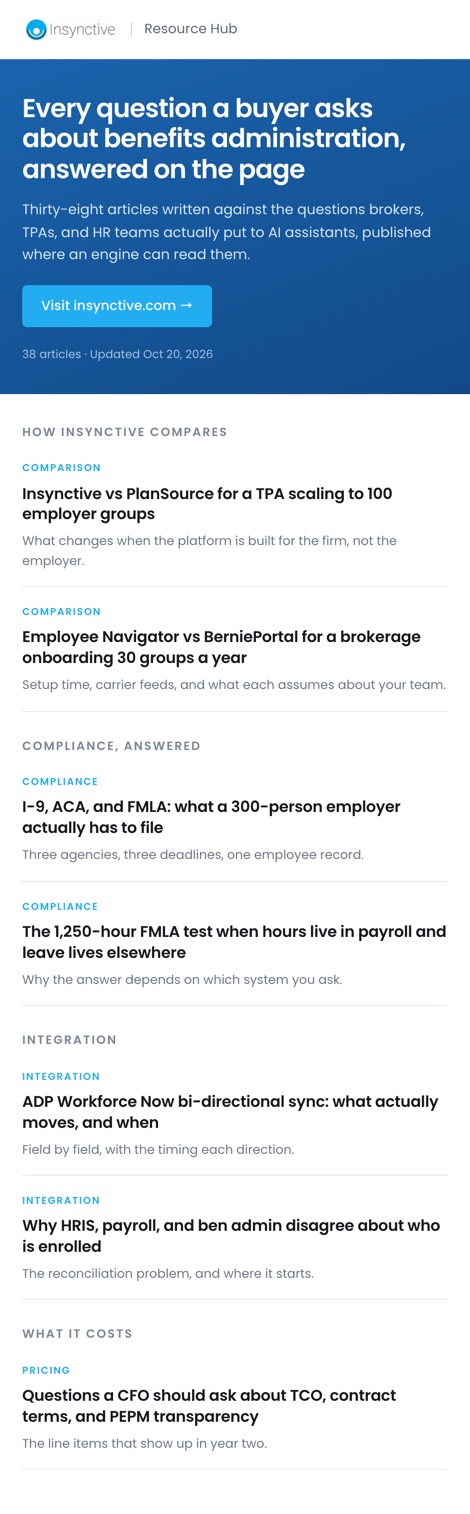
Here's what that looked like for Insynctive, a mid-market B2B HR tech platform, measured on the same 150 buyer questions and the same four engines before and after:
Commitment should match the proof. The Loop is $6,000 a month on a three-month minimum, then month to month, so the first re-asks land inside the term you signed.
Resonate Labs to confirmIf a client stops the Loop, do the pages published to their Studio stay live and stay theirs?
How does a written service level compare with the usual proposal?
Each row is one term to pin down: what proposals in this category commonly offer, what to ask for instead, and where Resonate Labs stands. Send the middle column to every vendor you're weighing.
| The term | Common in proposals | What to ask for | Resonate Labs |
|---|---|---|---|
| Delivery cadence | A monthly report and a call | A set number of pages every week | Three pages a week, landing in your Studio to approve |
| Measurement | A dashboard score, questions not shown | The same question set, re-asked on a set date | The same 150 questions re-asked monthly, with the month's movement |
| Question set | A generic keyword list | Questions written from your buyers, yours to edit | Written from your approved buyer map, and yours to adjust |
| Deliverables | Briefs and a deck | Files and pages you can open | Foundation, Visibility Report with a ranked action plan, then the pages |
| Approvals | Not stated | Rounds, turnaround, and slot rules in writing | You approve every page before it goes live |
| Commitment | A long retainer before you know where you stand | A paid first look, then a short minimum | $997 Crawl first, then $6,000 a month with a three-month minimum |
Sources: Resonate Labs pricing.
What should you ask every vendor before you sign?
Five questions, sent before the first call, sort a written service level from a repackaged retainer. Vendors with real answers reply with documents. The rest reply with a meeting invite.
- Which questions will you measure, and can I edit them?You want the list itself, written from your buyers. Resonate Labs hands over its full set of 150 free: start your free Foundation and it's in your account in about an hour.
- How many pages ship each week, and where do they go?A number and a place. "Content as needed" isn't a service level.
- When is the re-measure, and is it the same set on the same engines?A date on the calendar, and the same questions as the baseline, so the change means something.
- What happens when I reject a page, or the number stalls?Revision rounds, a named owner, and a response time in business days.
- What do I keep if we stop?The pages, the question set, and enough of the method that your team isn't back at zero.
Questions buyers ask about Resonate Labs engagements
The short version on timing, calls, commitment, and control of the question set.
How long does the first measurement take?
Your Foundation is in your account in about an hour. Once you approve it and authorize the Crawl, the question set locks and the report follows within 72 hours. Your card is charged when the report lands, not at checkout.
Do I have to get on a sales call?
Not for a Foundation or a Crawl: both are self-serve from start to delivery. Starting the Loop takes one short call to set your domain, your brand kit, and the first week's pages.
What if my team wants to do the work in-house?
Then buy the measurement and skip the retainer. Resonate Labs sells prepaid Crawl packs for teams that execute the plan themselves. The credits never expire and work on any site.
Can we change the questions being measured?
Yes. You can rewrite any of the 150, cut what doesn't describe your market, and add anything you want tracked. Nothing locks until you authorize the Crawl.
Does the first Crawl count toward the Loop?
In full. Whatever you paid, $997 or $2,497 with Voice of Customer, comes off your first Loop invoice if you start within 60 days of your report landing.
resonatelabs.co to confirmWhat do prepaid Crawl packs cost, and in what sizes are they sold?