Buyer's guide · AI visibility
Choosing an AI visibility partner for a B2B team. Score what happens after the number.
You've narrowed it to three kinds of option: an always-on tracker, a tracker that also fixes crawler access, and a partner that measures and then writes the pages. Here are six tests that separate them, and a scorecard you can take into the budget meeting.
Judge every option on six tests, and weigh four hardest: how deep the audit goes, how specific the plan is, who writes the pages, and whether you can see how the score is built. Resonate Labs asks 150 of your buyers' questions across ChatGPT, Claude, Gemini, and Perplexity, ranks the fixes, and can write the pages too.
After the first report, your team gets
- Always-on trackerA trend line and alerts
- Tracker with crawler fixesA trend line, plus technical fixes
- Resonate LabsA ranked plan, critical work first, and the pages if you hand them over
↻ Measured, written, published, measured again
The shortlist problem
Every option on your shortlist will show you a score. Ask what happens next.
Your CEO wants to know why buyers shortlist competitors inside ChatGPT and never mention you. Any option on your list will hand you a number for that. The number is the easy part. What decides your next two quarters is who turns it into pages the engines quote.
Pick on chart quality alone and you can end up where plenty of teams already are: a weekly score of 9%, four months running, and nobody sure which page to publish. That's a line in your budget with nothing shipped against it.
The usual advice is to buy whatever covers the most engines and refreshes most often. That's sound if you have writers waiting for direction. If your team is already stretched, more frequent readings of the same gap won't close it.
A dashboard tells you you're at 9%. A ranked plan tells you which page to publish Monday.
So score each option on what it hands your team after the first report, and then on who does the work.
The checklist
Six tests for any AI visibility option.
Run these on every vendor call. Each one says why it matters and where Resonate Labs stands, so you can hold every option to the same bar.
-
01
The questions come from your buyers
A score is only as good as the questions behind it. A generic set describes your category the way the web has written about it, so a good number can mean the category is well covered while you aren't. Ask who wrote the questions and whether you can edit them.
Resonate Labs writes 150 questions from your Foundation, a free map of who buys from you, and you can rewrite, cut, or add to any of them before the Crawl runs. At $2,497, Voice of Customer reads the sales calls you already record and rewrites the questions in your buyers' own words.
-
02
The audit checks whether AI can read your site at all
If your site renders in JavaScript, AI crawlers can get an empty page while Google sees the real thing. No amount of new content fixes that. An audit that only counts mentions will miss it, and you'll write pages the engines can't read.
Resonate Labs checks whether the AI crawlers can read your site in the free Foundation. The AI Visibility Crawl then scores every answer, measures your share of voice against named competitors, and shows the pages engines cite instead of yours.
-
03
The plan names the work, in order
A list of topics you're weak on still leaves your team to work out what to publish. Look for a plan ranked by impact, with each item tied to the questions it would move. It should also cover the review sites and threads engines quote, since your own pages are only part of the answer.
Resonate Labs ends every Crawl with a ranked action plan, critical work first, each item tied to the questions it would move. It includes off-domain briefs: the third-party sources to go after, and what each one needs to say.
-
04
Someone can write and ship the pages
Visibility moves when pages ship. If your team has no writing capacity, a measurement-only tool leaves the gap visible and open. Ask whether the vendor can do the writing, and whether you keep approval of what goes live.
Resonate Labs runs the Resonate Loop: three pages a week written against your action plan, landing in a Studio on your own subdomain for you to approve. It's $6,000 a month on a three-month minimum, and what you paid for your Crawl comes off the first invoice if you start within 60 days of your report.
Resonate Labs to confirmDoes the Loop also act on the off-domain briefs (review sites, community threads, roundups), or only publish pages to your Studio?
-
05
You can see how the score is built
When your CEO asks where the number came from, "the tool says so" won't hold. You need the question set, the engines, and the method in writing. You also need the same questions re-asked on the same engines, or a swing between readings can just be noise.
Resonate Labs includes a Method & sources section in both the Foundation and the Visibility Report, and you can open a filled-in sample report before you buy anything. Each month on the Loop, it measures again with the same questions, the same engines, and the same baseline.
Resonate Labs to confirmHow is each AI answer scored in the Crawl, and is that scoring method written up anywhere a buyer can read before ordering?
-
06
You can find out where you stand before you commit
You shouldn't have to sign a monthly retainer and wait a quarter to learn whether you have a problem. Look for a one-time first reading with a clear price and a date it lands.
Resonate Labs builds your Foundation free, with no card, in about an hour. One AI Visibility Crawl is $997, charged when the report is delivered, usually within 72 hours.
The scorecard
Three kinds of option, side by side.
Each kind wins somewhere. An always-on tracker is the simplest way to watch a trend line every day, and it's the right pick if you already have writers waiting for direction. Resonate Labs fits teams that need the audit, the ranked plan, and the option to hand over the writing.
| What to check | Resonate Labs | Always-on tracker | Tracker with crawler fixes |
|---|---|---|---|
| Where the questions come from | 150 written from your buyer map, yours to edit before anything runs | Ask whether you write or approve the prompt list | Ask whether you write or approve the prompt list |
| Audit depth | Crawler readability, share of voice, head-to-head record, cited pages, and off-domain sources | Mentions and share of voice over time | Mentions over time, plus crawler access |
| Action plan | Ranked, critical work first, each item tied to the questions it would move | Ask to see a sample of what you'd receive | Surfaces technical and content work to do |
| Who writes the pages | Your team, or the Loop: three pages a week for your approval | Your team | Your team |
| Method you can read | Method & sources section in every Foundation and Visibility Report | Ask to see it in writing | Ask to see it in writing |
| How often it measures | Per Crawl, or monthly on the Loop | Continuously, with trend lines Better fit for daily tracking | Continuously |
| First commitment | Foundation $0, then a $997 Crawl charged on delivery | A monthly subscription | A monthly subscription |
Sources: Resonate Labs pricing and the Resonate Labs home page. The other two columns describe kinds of tool, not any one vendor, so check each vendor's own terms.
Case study
What happens when the pages actually ship.
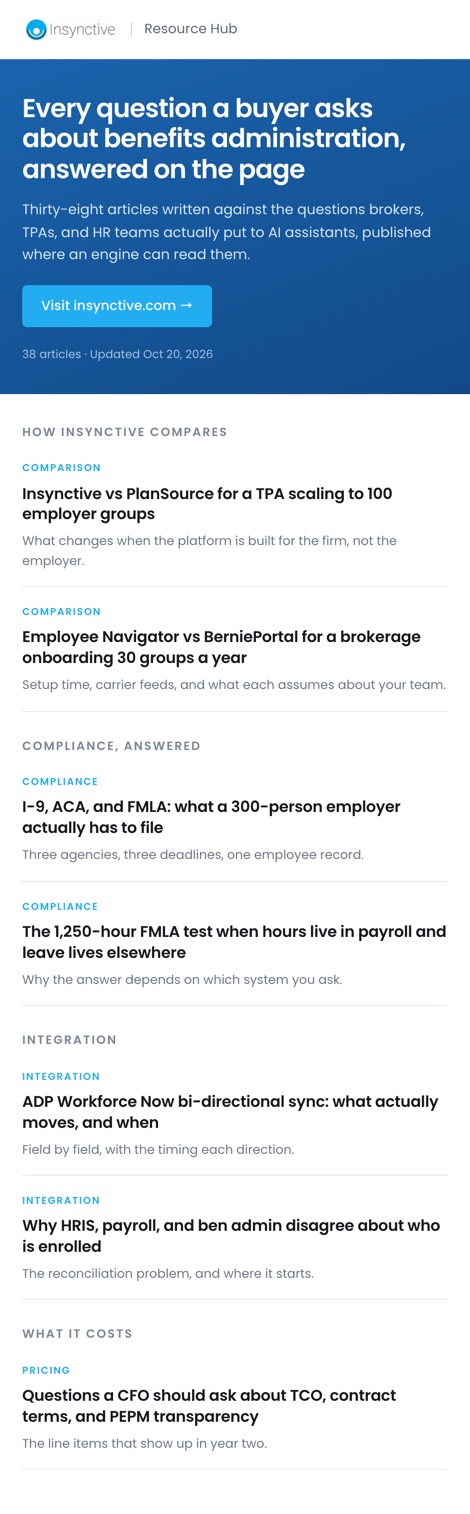
Insynctive, a mid-market B2B HR tech platform, ran the Loop against the same 150 buyer questions on the same four engines, measured before and after. It went from showing up on 2 of those questions to 24 by week six.
- 38Pages shippedNet-new server-rendered pages in the first four weeks.
- +504%ChatGPT bot trafficGPTBot crawl volume over baseline, once the site became readable.
- 12xMore visible by week six2 of 150 buyer queries to 24, on a matched set.
Crawler traffic moved first, and citations followed within the month as the engines indexed the new pages. That's the order to expect from any option that ships content: access, then indexing, then answers. Read the full Insynctive case study.
On the call
Five questions to ask every vendor.
Ask each vendor these in the same words, and write down what you hear. A vague answer tells you as much as a specific one.
- Who writes the questions you measure, and can I change them before you run them?
- Will your audit tell me if AI crawlers can't read my site?
- After the first report, does my team get a chart, a list of topics, or a ranked list of pages to publish?
- If we have no writers, who ships the pages, and do I approve them before they go live?
- Can I read your method before I pay, and do you re-ask the same questions every time?
Red flag: a vendor who says they do AI visibility but can't show you a question set or a sample report. That's often last year's search retainer with a new deck.
Want to see those answers for your own site first? Build your Resonate Labs Foundation: it's free, and the 150 questions are yours to keep.
FAQ
Questions people ask
Short answers to what buyers ask most when Resonate Labs is on the shortlist.
Is Resonate Labs just a measurement tool?
No. The AI Visibility Crawl is the measurement and the ranked plan, and the Resonate Loop writes three pages a week against that plan, published to a Studio on your subdomain once you approve them. You choose whether to run the work yourself or hand it over.
When is an always-on tracker the better choice?
When you already have writers and someone who owns AI visibility, and what you mainly want is a daily trend line with alerts. A tracker shows movement continuously, while a Crawl is a reading you repeat on your own schedule.
How long until I know where we stand?
Your Foundation is in your account in about an hour, free. Once you approve it and authorize the Crawl, the Visibility Report follows within 72 hours, and your card is charged only when it lands.
Can we do the work in-house and still keep measuring?
Yes. Crawl packs are prepaid credits, three for $2,691 or six for $4,782. They never expire and work on any URL.
Will an AI visibility audit prove pipeline impact?
The Crawl reports visibility: where you appear, who appears instead, and which pages the engines cite. Ask any vendor how they would connect that to pipeline, because research done inside AI assistants often shows up in analytics as direct traffic.
Find out where you stand. Then decide who does the work.
Enter your website and your Foundation is in your account in about an hour, with no card and no sales call. It's yours to keep even if you never order a Crawl.
Build your Foundation